Every purchasing decision carries an environmental and social cost. Some costs are visible — the price tag, the fuel used to deliver a parcel — and some are hidden in supply chains that stretch across continents and involve labour conditions most consumers never see. Fast fashion is one of the most studied examples of the hidden costs of leisure spending, but it is far from the only one. Comparing different leisure choices through the lens of sustainability reveals something interesting: not all entertainment is created equal, and the most enjoyable options are not always the most impactful ones.
This article examines what fast fashion, online entertainment and other leisure spending categories actually cost the planet and the people who produce them, and what choosing differently might mean for those who want their spending to reflect their values.
The True Cost of Fast Fashion
Fast fashion is built on a model of rapid production, aggressive pricing and the encouragement of constant consumption. The industry produces an estimated 100 billion garments per year globally, far more than can be worn or absorbed by the market. The surplus ends up in landfill, incineration sites or dumped in developing countries, where it pollutes waterways and contributes to land degradation.
The environmental footprint of a single garment is larger than most consumers imagine. Cotton cultivation is water-intensive, with a single t-shirt requiring roughly 2,700 litres of water to produce. Synthetic fibres like polyester, which make up the majority of fast fashion output, are derived from fossil fuels and shed microplastics with every wash. Dyeing and finishing processes use toxic chemicals that contaminate local water supplies in production countries. And the logistics of a global supply chain, from raw material to finished garment to consumer door, generate significant carbon emissions at every stage.
The social cost is equally significant. The garment industry employs an estimated 300 million people worldwide, many of them in conditions that fall well short of basic labour standards. Low wages, unsafe working environments and the suppression of union activity are structural features of the fast fashion supply chain, not aberrations. The Rana Plaza collapse in Bangladesh in 2013, which killed over 1,100 garment workers, brought global attention to these conditions, but the structural pressures that created them have not been resolved.
For consumers who care about these issues, Sustainable Fashion in Dublin offers a practical alternative rooted in the Irish context, helping people navigate the choices available to them without needing to disengage from fashion entirely. The path forward is not about wearing nothing, but about wearing differently.
What Makes Entertainment Sustainable or Unsustainable
Leisure spending covers an enormous range of activities, and their environmental profiles vary considerably. A long-haul flight for a weekend break has a carbon footprint that dwarfs almost any domestic activity. Attending a music festival involves transport, energy use, food waste and single-use materials on a large scale. Buying tickets to a major sporting event, eating out multiple times a week or purchasing the latest consumer electronics all carry their own embedded costs.
Digital entertainment sits at the low-impact end of this spectrum. Streaming a film, playing an online game or using an online casino platform requires electricity to power devices and data centres, but the per-hour environmental cost of these activities is substantially lower than most physical alternatives. No physical goods are produced, no logistics network is activated and no supply chain of questionable ethics is engaged. The entertainment exists and is consumed entirely in digital form.
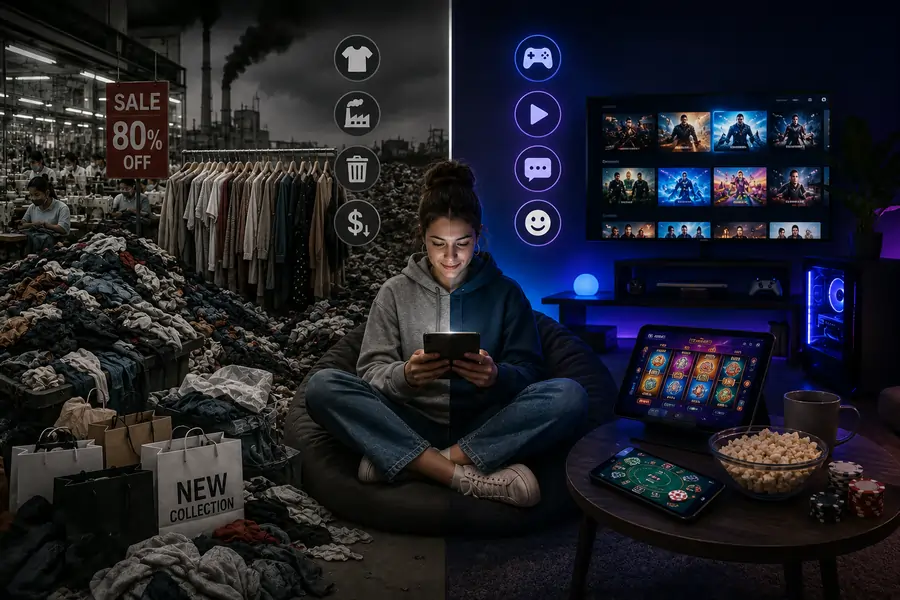
This does not mean digital entertainment is zero-impact. Data centres consume significant energy globally, and the emissions profile of that energy depends heavily on the electricity grid it draws from. But the comparison with fast fashion — which involves physical production, global logistics, retail infrastructure and disposal at the end of a garment’s short life — is stark. Choosing to spend a leisure evening on an online platform rather than purchasing an item of fast fashion that will be worn twice is, from a purely environmental perspective, a significantly better choice.
Online Gaming as Low-Footprint Leisure
Online gaming in its various forms has become one of the most popular leisure activities globally. Casino gaming in particular has migrated substantially from physical venues to online platforms in the past decade, driven by convenience, improved user experience and the broad availability of mobile access. For players in Belgium and across Europe, platforms like dicespin.org/be/ offer a full range of casino games accessible from any device, without the transport, energy and resource costs associated with visiting a physical casino.
The comparison between a night at a physical casino and an evening on an online platform illustrates the sustainability argument clearly. A physical casino visit involves travel, a venue that requires continuous lighting, heating and staffing, and the full infrastructure of a hospitality business. An online session requires a charged device and a data connection. The entertainment value can be equivalent; the environmental cost is not.
This does not mean online gaming is without any footprint, and it certainly does not mean it should replace all other forms of leisure. The argument is more modest: when choosing between leisure options, the environmental profile of each is a legitimate factor to consider, and digital entertainment generally performs well on that measure.
The Psychology of Conscious Consumption
Understanding why people continue to buy fast fashion despite knowing its costs requires looking at the psychology of consumption. Fast fashion exploits well-documented psychological mechanisms: the dopamine hit of novelty, the social signalling function of new clothing, the sense of agency that comes from making a purchase and the way that low prices make consumption feel low-stakes even when the aggregate impact is substantial.
The same mechanisms operate in other areas of leisure spending. The appeal of a new experience, the social dimensions of entertainment and the ease of digital purchase all contribute to consumption patterns that are difficult to change through information alone. Research on behaviour change consistently shows that providing people with more sustainable alternatives that are equally or more enjoyable is more effective than asking them to simply consume less.
This is part of the argument for platforms that offer genuine entertainment value at low environmental cost. The substitution of a high-impact leisure choice with a lower-impact one that satisfies the same underlying need — entertainment, stimulation, the possibility of reward — does not require consumers to sacrifice enjoyment. It requires them to redirect it.
Making the Comparison Practical
For someone trying to audit their leisure spending through a sustainability lens, a few questions are useful. First, does this purchase involve the production of a physical good, and if so, what are the conditions under which it was made? Second, does it involve significant logistics, travel or energy infrastructure? Third, is the entertainment or satisfaction it provides available in a lower-impact form?
Applying these questions to fast fashion produces a fairly damning set of answers. The production of physical garments at high speed and low cost involves significant environmental and social costs. The logistics of global supply chains are carbon-intensive. And the satisfaction of having something new to wear is genuinely available in lower-impact forms: second-hand clothing, clothing rental, capsule wardrobes and a deliberate relationship with the items already owned.
Applying the same questions to online entertainment produces more favourable answers. No physical good is produced. The logistics footprint is minimal. And the entertainment value is real and directly available without engaging a supply chain of questionable ethics. This does not make online entertainment a moral imperative, but it does make it, by the standards of environmental impact, a relatively responsible leisure choice.
Values and Choices
Leisure spending is ultimately a reflection of values, whether or not consumers are conscious of that connection. The collective effect of individual choices at scale determines the market conditions that producers respond to. A fashion industry that faces declining demand for fast fashion and growing demand for sustainable alternatives will change; the evidence from recent years suggests this shift is already underway, driven by consumers who have decided that their spending should reflect what they actually believe.
The same logic applies across leisure categories. Choosing entertainment options with lower environmental footprints, being thoughtful about the emissions cost of travel and recreation, and avoiding the impulse purchase of physical goods in favour of experiences and digital alternatives all contribute to a more sustainable pattern of consumption. None of these choices requires significant sacrifice. They require attention, which is a different and more manageable ask. For more information on sustainable fashion and ethical consumption in Ireland, the Environmental Protection Agency’s circular economy resources offer practical guidance on reducing the environmental impact of everyday choices including clothing and consumption.